

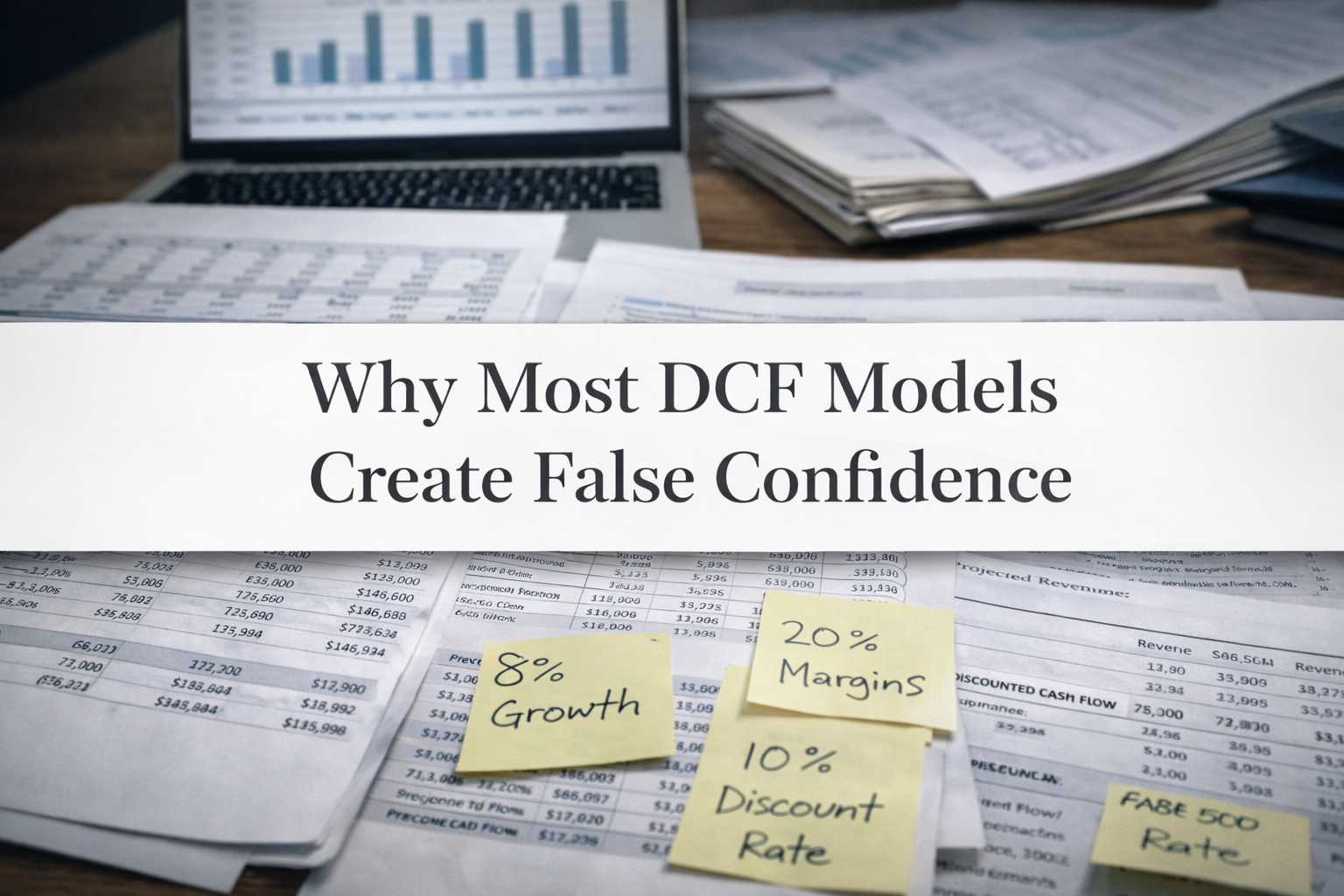
Structured models can appear precise, even when the assumptions underneath remain uncertain.
At some point, every analyst builds a DCF model that feels convincing.
Not just usable — convincing.
The numbers line up, the assumptions don’t look aggressive, and the output lands somewhere that feels… reasonable. Close enough to market, but not exactly the same. Different enough to feel like insight.
That’s usually the moment confidence sets in.
And it’s also where things start to go wrong.
Because the model hasn’t reduced uncertainty. It has only made it easier to overlook.
Why This Matters
DCF models are treated, especially in academic settings and early-stage roles, as the most disciplined way to approach valuation. They force you to be explicit. They don’t let you hide behind vague narratives. Everything has to be written down, linked, and reconciled. This becomes clearer when you step back and examine what financial modeling really does — not as a tool that discovers value, but as one that structures assumptions about a business.
That’s valuable.
But it also creates a subtle shift in how the output is interpreted.
Once something is expressed numerically — especially inside a structured model — it begins to feel more reliable than it actually is. The structure itself carries weight. It signals rigor, even when the underlying thinking is still uncertain.
So what ends up happening is not that analysts trust bad models. It’s that they trust well-built models a little too much.
A well-built model can still encode a fragile view of the business, and because that view is expressed numerically, it can feel more reliable than it actually is.
This is closely related to when valuation models give false confidence, especially when structure is mistaken for certainty.
This distinction matters because valuation is rarely about calculation
What the Model Feels Like It’s Doing
If you step back, the logic of a DCF is hard to argue with.
You’re estimating how much cash a business will generate over time. You’re adjusting that for risk. And you’re bringing it back to today’s value.
There’s nothing obviously flawed about that.
And when you build it out — revenue growth, margins, reinvestment, discount rate — each piece can be justified. You can point to history. You can point to industry benchmarks. You can explain every number if someone asks.
Which is why the final output feels earned.
But here’s the part that usually doesn’t get enough attention:
The model doesn’t just organize numbers. It organizes beliefs.
Where the Confidence Starts to Drift
Most people would agree that assumptions matter.
What’s less obvious is how those assumptions change once they are written down as precise numbers.
Take revenue growth.
You might say, “8% seems reasonable.” And maybe it is — relative to history, peers, or market expectations.
But what does that actually mean?
It means you’re assuming the company can maintain its position, that the market doesn’t shift meaningfully, that competition doesn’t intensify in a way that disrupts pricing or volume. It assumes execution stays on track. It assumes no major surprises.
None of those are directly visible in the model.
All of them are sitting inside that one number.
The problem is not the number itself.
It’s how much uncertainty it’s hiding.
What the Model Actually Does
It helps to stop thinking of a DCF as something that “finds value.”
It doesn’t.
What it really does is take a view of the future — often a simplified one — and express it in a way that looks precise.
That’s useful. But it’s also where the illusion starts.
Because once everything is quantified, it becomes harder to see what is still uncertain.
The model gives you a number.
It doesn’t tell you how fragile that number is.
This becomes even more relevant when thinking about cash flow vs earnings, and how each shapes what the model is actually capturing.
A Small Change That Isn’t Small
Consider how sensitive most models are to growth.
You move from 8% to 6%, and the valuation drops. Move to 10%, and it rises.
On paper, that’s just sensitivity.
In reality, those are different stories about the business.
6% might reflect competitive pressure or a maturing market.
10% might assume stronger positioning or continued expansion.
The model treats these as small adjustments.
But they are not small in meaning.
They reflect different views of how the business evolves.
And the model doesn’t help you choose between them.
Two Analysts, Same Model
This is where things become more interesting.
Take two analysts looking at the same company. Same data, same general framework, even similar modeling structure.
One leans slightly more optimistic — maybe not aggressively, just enough to believe the company can sustain growth and expand margins over time.
The other is more cautious — not bearish, just more sensitive to competition and reinvestment needs.
Both models will work.
Both will be internally consistent.
And both will produce valuations that look precise.
But they won’t match.
Not because one model is wrong — but because each model reflects a different interpretation of the same business.
That difference doesn’t disappear inside the spreadsheet.
It gets translated.
What Usually Gets Missed
A lot of effort in financial modeling goes into improving the model itself.
Cleaner structure. Better linking. More detailed assumptions.
All of that helps.
But it can also shift focus away from where most of the risk actually sits.
Which is not in the formulas.
It’s in the assumptions.
You can build a very sophisticated model around a set of assumptions that are only slightly off — and the output will still look precise.
That’s the uncomfortable part.
The model can be technically strong and still directionally misleading.
Where Models Struggle Quietly
Another issue is how models handle interactions between variables.
Growth doesn’t happen in isolation. It often requires reinvestment. That reinvestment affects cash flow. It can also affect returns.
Margins don’t expand indefinitely without attracting competition. And competition, in turn, affects growth.
These relationships exist in reality.
In models, they are often simplified.
Not because analysts don’t understand them — but because they are difficult to capture cleanly.
So the model ends up being slightly more stable than the business it represents.
And that stability feeds confidence.
When DCF Actually Helps
None of this means DCF models are useless.
They work best when the business itself is relatively stable.
If demand is predictable, margins are consistent, and reinvestment patterns are clear, then the range of outcomes narrows. The assumptions still matter, but they are less volatile.
In those cases, the model becomes a useful way to structure thinking and test how different variables interact.
Even then, though, it’s better to think in ranges than in single numbers.
When Confidence Becomes Misleading
Problems show up when the underlying business is less stable.
Early-stage companies. Rapidly evolving industries. Businesses where margins shift or capital requirements change.
In those cases, small changes in assumptions lead to large changes in valuation.
The model still produces a clean output.
But that output is built on inputs that are moving more than the model suggests.
And that’s where confidence becomes fragile.
What’s Not Worth Obsessing Over
There’s a tendency to focus on the visible parts of the model.
Fine-tuning projections. Adjusting discount rates. Tweaking minor inputs to see how the valuation moves.
Some of that is necessary.
But it’s often not where the real uncertainty lies.
The bigger questions — around durability of growth, competitive positioning, reinvestment needs — are harder to quantify. So they get less attention.
Even though they matter more.
Key Takeaways
DCF models don’t eliminate uncertainty. They reorganize it.
The precision you see in the output reflects how specifically assumptions are defined — not how certain they are.
Two analysts can look at the same business, use similar models, and still disagree in a meaningful way.
And in many cases, that disagreement is the most important signal.
Boundaries
This isn’t a critique of DCF as a tool.
It’s a reminder of what it actually does.
A model can be clean, consistent, and technically sound.
That doesn’t make the underlying assumptions stable.
And if that distinction isn’t clear, it becomes very easy to confuse structure with certainty.
FAQ
Part of it is the structure. When everything is laid out — assumptions, projections, discounting — it gives the impression that nothing has been left vague. And that’s comforting. But the structure can hide how much of the model still depends on judgment. It feels complete, even when the underlying assumptions aren’t.
It still is. The usefulness isn’t in the number it produces, but in forcing you to be explicit about what you’re assuming. That alone has value. The problem starts when the output is treated as an answer rather than a conditional outcome.
Because those inputs don’t just affect one line — they run through the entire model. Growth changes future cash flows, which then affect reinvestment, which then affects terminal value. So even a small adjustment ends up compounding across multiple layers. It looks like a minor tweak, but it usually reflects a different view of the business.
Spending too much time improving the model and not enough time questioning the assumptions. It’s easier to fix formulas than to think through whether a growth rate actually makes sense. But that’s usually where the real risk sits.
More like a conditional statement than a conclusion.
“If these assumptions hold, then this valuation makes sense.”
The tricky part is that the model only shows the outcome clearly. The assumptions behind it need a bit more effort to keep in focus.
About the Author