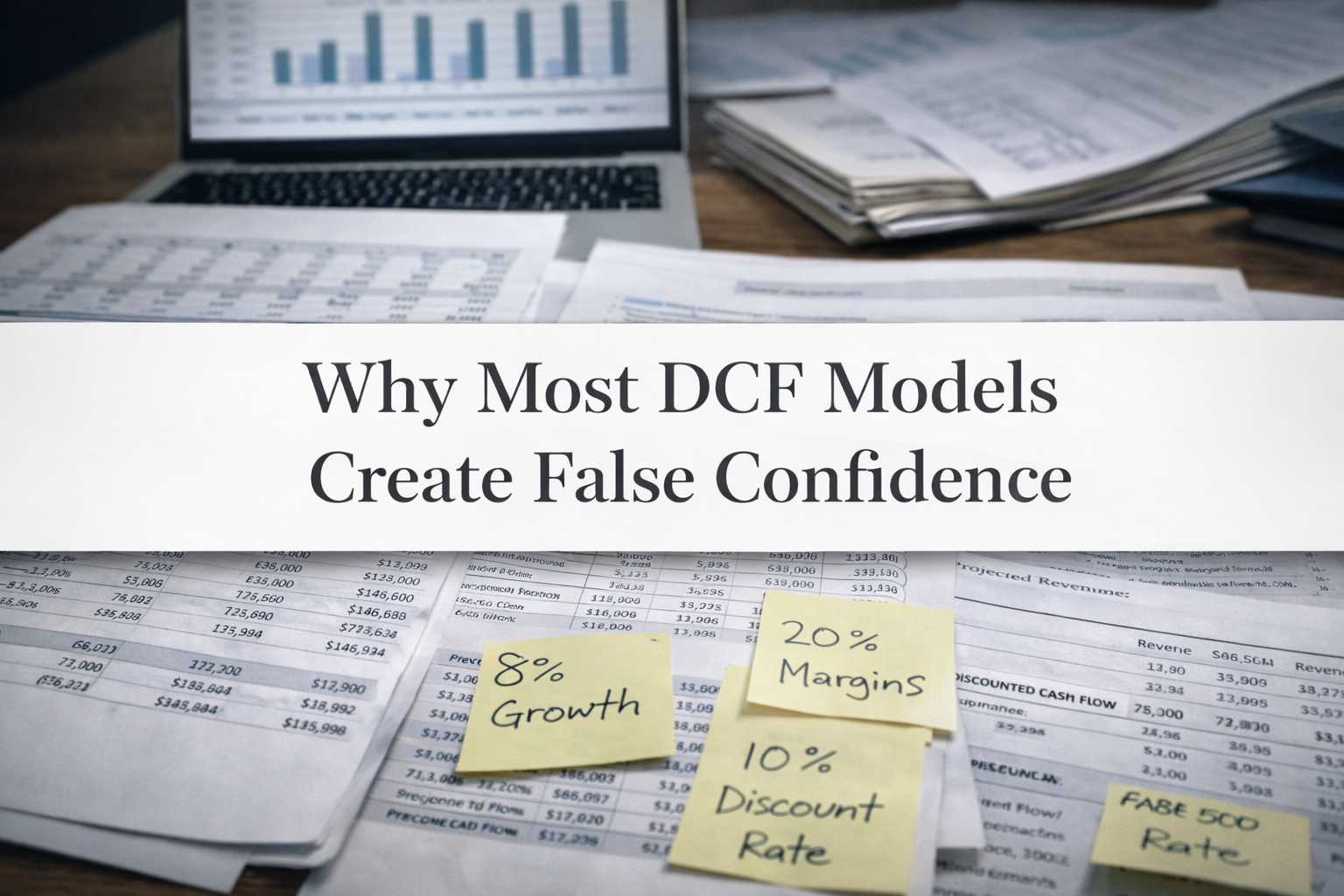


Valuation models organize assumptions about business economics—but their conclusions depend entirely on those assumptions
A company can look attractively valued in a spreadsheet long before anyone truly understands its business.
The model appears precise. The assumptions are organized. The output produces a neat intrinsic value estimate.
At that point many investors feel a sense of analytical control. The numbers look disciplined, the logic appears structured, and the valuation feels objective.
This is where analysis quietly becomes dangerous.
The problem is not the valuation model. The problem is the assumption behind the model, and we need to evaluate further.
A valuation model does not discover value. It translates assumptions into numbers. When those assumptions are sound, the model can sharpen judgment. When they are fragile, the same model can create an illusion of precision.
Understanding that distinction is where disciplined valuation begins.
Why This Matters for Investors
Most investors treat valuation models as if they produce answers.
They build a discounted cash flow model, adjust a few inputs, and interpret the resulting number as the “true value” of the business.
The process feels analytical. But in practice, it often reverses the correct order of thinking.
Professional analysts rarely start with the model. They start with the business.
Only after forming a view about the economics of the company do they use valuation models to test whether their assumptions are internally consistent. This is closely related to the idea of how to analyze a US stock without too many metrics, where business understanding comes before spreadsheet modeling.
In other words, the model is a tool for organizing judgment, not a substitute for it.
When investors misunderstand that relationship, valuation models can produce false confidence instead of clarity.
What Most Valuation Models Appear to Do
At the surface level, valuation models look straightforward.
An investor estimates future cash flows, chooses an appropriate discount rate, calculates a terminal value, and arrives at a present value estimate using a discounted cash flow valuation model.
The mechanics feel scientific. The spreadsheet contains formulas rather than opinions. Small changes in inputs generate immediate outputs.
Because of this structure, valuation models often feel more reliable than they actually are.
Consider a simplified example.
An investor estimates that a company will generate $100 million in free cash flow next year and grow at 5% annually for the next decade. Using a 9% discount rate, the model calculates a present value of roughly $1.3 billion.
The numbers appear precise. But every component of the model rests on an assumption.
Will growth actually remain stable for ten years?
Will margins stay constant?
Will capital intensity remain unchanged?
The spreadsheet cannot answer these questions. It simply converts them into mathematics.
This looks analytical until the assumptions begin to shift.
Where Surface-Level Analysis Breaks Down
The most common mistake investors make with valuation models is believing that mathematical precision equals analytical certainty.
It does not.
A discounted cash flow model can produce a valuation estimate accurate to the nearest dollar, but the assumptions behind it are often uncertain. This is part of the broader issue explained in why most beginner stock analysis guides fail in real markets, where formulas create the illusion of certainty.
This becomes problematic when small changes in assumptions create large changes in valuation.
For example, adjusting the long-term growth rate from 5% to 4% might reduce the valuation estimate by hundreds of millions of dollars. Increasing the discount rate by one percentage point can produce a similarly large shift.
The model itself is not wrong. The formulas are correct.
The instability comes from the assumptions embedded inside the model.
This is why professional analysts rarely interpret valuation outputs as precise numbers. Instead, they think in ranges.
The model does not produce a verdict. It produces a sensitivity map.
When Valuation Models Actually Help
Despite their limitations, valuation models remain extremely useful when used correctly.
Their value lies in forcing investors to confront the economic implications of their assumptions.
Consider a mature business with relatively stable cash flows.
Suppose an investor believes the company can grow earnings at 6% for the next decade. A valuation model immediately tests whether that belief is consistent with current reinvestment levels and capital returns.
If the company reinvests only 20% of its earnings, the model may reveal that sustained 6% growth requires unrealistic improvements in efficiency or margins.
In this situation the model performs a valuable function. It exposes hidden inconsistencies in the investor’s reasoning.
The spreadsheet is not generating insight on its own. It is forcing the analyst to reconcile assumptions with economic reality.
This is where valuation models genuinely improve analytical discipline.
When Valuation Models Create False Confidence
The same models become misleading when they are used before the business is properly understood.
In practice, many investors begin with the spreadsheet.
They project revenue growth based on recent trends. They estimate margins based on industry averages. They assume capital expenditures remain stable.
These inputs look reasonable individually. But they often ignore the underlying economic structure of the business.
For instance, a software company and an industrial manufacturer may both report 10% revenue growth. Yet the capital required to sustain that growth can differ dramatically. This is one reason comparing companies using one metric rarely works, even when the numbers appear similar.
The model may treat both cases similarly if the assumptions are entered mechanically.
This is where valuation models create false confidence.
The spreadsheet appears analytical, but the assumptions embedded within it may not reflect the actual economics of the business.
The formulas are correct. The interpretation is not.
Two Analysts, Same Data, Different Conclusions
One of the most instructive aspects of valuation analysis is that competent analysts often reach different conclusions from the same data.
Consider a company generating $500 million in free cash flow with moderate growth expectations.
Two analysts build valuation models using similar financial information. Yet their conclusions diverge significantly.
The reason often lies in how they interpret growth durability, reinvestment needs, and competitive advantage. These valuation assumptions in discounted cash flow models are what ultimately drive the output of the model.
The first analyst focuses on the company’s competitive position and pricing power. They believe the business can sustain strong margins and modest reinvestment needs for many years.
Their model assumes steady growth and stable returns on capital. The resulting valuation appears attractive relative to the current market price.
The second analyst emphasizes industry disruption and technological change. They believe margins will gradually compress as competition increases.
Their model assumes lower long-term profitability and higher reinvestment requirements. The valuation estimate becomes significantly lower.
Both analysts used valuation models. Both performed mathematically correct calculations.
The difference lies in how they interpret the durability of the underlying business economics.
The model did not resolve the disagreement. It simply translated each analyst’s assumptions into numerical form.
What Most Investors Miss
Many investors focus on the mechanics of valuation models rather than the economic logic behind them.
They debate whether the correct discount rate should be 8% or 9%. They refine terminal value formulas. They adjust growth projections with decimal-level precision.
These refinements create the appearance of rigor.
However, the most important variables in any valuation model are rarely numerical.
They involve qualitative judgments about competitive advantage, industry structure, capital allocation, and reinvestment opportunities.
For example, a company with strong pricing power may sustain high margins even during economic slowdowns. Another company operating in a commodity-like industry may experience sharp margin compression when supply increases.
These dynamics cannot be captured fully through spreadsheet formulas.
Yet they determine whether the assumptions inside the model are realistic.
Ignoring those structural factors while perfecting spreadsheet mechanics is one of the most common analytical mistakes in valuation.
What Investors Should Stop Focusing On
Several aspects of valuation models receive far more attention than they deserve.
First, investors often obsess over the exact intrinsic value number produced by a model.
This precision is misleading. The output of a valuation model is only as reliable as the assumptions driving it. The same reasoning explains why a low P/E ratio often misleads retail investors—the metric itself is not wrong, but the assumptions behind it can be fragile.
Second, many discussions focus on choosing the “correct” discount rate.
In practice, small differences in discount rates matter less than misunderstandings about long-term business economics.
Finally, investors frequently treat valuation models as predictive tools.
They are not designed to forecast stock prices or market timing. Their purpose is to organize thinking about how business economics translate into long-term value.
When the model is treated as a forecasting machine, its limitations become unavoidable.
When Valuation Models Work Best
Valuation models tend to be most helpful in situations where the underlying business is relatively stable and predictable.
Mature companies with established competitive positions often fit this description.
In these cases, future cash flows may be uncertain but not chaotic. Growth rates evolve gradually, capital intensity remains relatively stable, and margins fluctuate within a narrow range.
Under those conditions, valuation models can provide a structured way to estimate the economic value implied by reasonable assumptions.
The model does not eliminate uncertainty, but it helps organize it.
By contrast, valuation models become far less reliable when applied to businesses undergoing rapid structural change.
Young technology companies, emerging industries, or businesses facing major disruption often experience unpredictable growth paths and evolving economics.
In these environments, long-term projections can become speculative very quickly.
The spreadsheet still produces a number, but the confidence implied by that number may be unwarranted.
The Real Role of Valuation Models
Seen correctly, valuation models perform a modest but valuable role.
They translate narratives about business economics into structured numerical implications.
If an investor believes a company will grow steadily with strong margins and disciplined reinvestment, the model shows what those beliefs imply for long-term value.
If those assumptions prove unrealistic, the model reveals the gap.
But the model cannot determine whether the assumptions themselves are correct.
That judgment depends on understanding industry dynamics, competitive advantages, management behavior, and capital allocation decisions.
These factors exist outside the spreadsheet.
Key Takeaways
Valuation models do not discover value. They convert assumptions about future economics into numerical estimates.
Mathematical precision should not be confused with analytical certainty.
The usefulness of a valuation model depends primarily on the quality of the assumptions embedded within it.
Competent analysts can reach different conclusions from the same data because they interpret business durability differently.
The most important inputs in any valuation model involve judgment about competitive dynamics, not spreadsheet formulas.
Valuation models work best as tools for organizing thinking rather than generating definitive answers.
FAQ
Are valuation models like discounted cash flow models accurate?
They can be useful, but their accuracy depends entirely on the assumptions used. Small changes in growth, margins, or discount rates can significantly alter the valuation estimate.
Why do professional investors still use valuation models?
Professionals use them to test assumptions and explore valuation ranges. The model helps organize thinking but does not replace business analysis.
Can a valuation model determine the intrinsic value of a stock?
It can estimate a range of possible values based on assumptions. However, those assumptions are inherently uncertain, so the output should be interpreted cautiously.
When are valuation models most reliable?
They tend to be more useful for mature businesses with relatively stable cash flows and predictable reinvestment needs.
A valuation model can produce a precise number.
A business rarely behaves with that level of precision.
Understanding that gap is where thoughtful valuation begins.
About the Author