
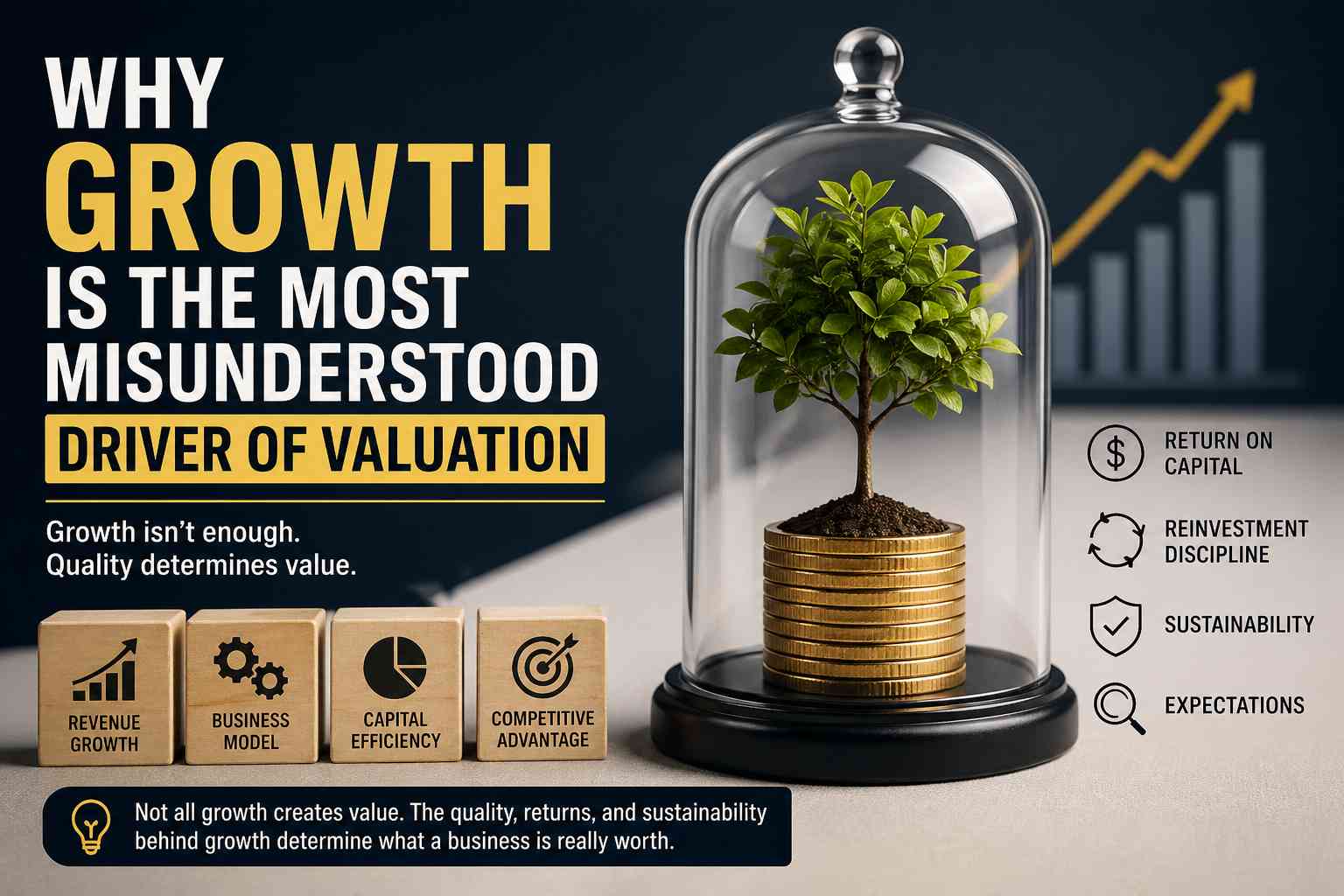
Growth only creates value when supported by capital efficiency and disciplined reinvestment
Revenue is growing. Margins look stable. The narrative feels tight. And yet valuations don’t always move the way investors expect.
Sometimes high-growth companies look expensive but continue to outperform. Other times, strong growth fails to translate into shareholder returns. The confusion is not about growth itself.
The problem is the assumption behind it.
Most investors treat growth as a direct driver of value. In practice, growth is conditional. It creates value only when certain underlying economics hold — and when they don’t, growth can actively destroy value even while reported numbers look impressive. That distinction is where analysis becomes uncomfortable, and where most published research stops short.
Why This Matters for Investors
Growth sits at the center of almost every valuation discussion. It influences multiples, forecasts, narratives, and expectations. But the way growth gets interpreted is consistently oversimplified.
The implicit assumptions are predictable: higher growth equals a higher valuation, faster growth signals a better business, and growth justifies premium multiples. This sounds logical. It often works at the surface level. But in practice, growth interacts with reinvestment, returns on capital, and risk in ways that aren’t immediately visible — and if that interaction is misunderstood, valuation becomes guesswork dressed up as analysis.
The Surface-Level View: Growth as a Positive Signal
At a basic level, growth appears straightforward. A company increasing revenue from $100 million to $150 million is expanding its business. If that growth continues, future earnings should be higher. Higher future earnings should justify a higher valuation today.
But this is similar to why a low P/E ratio often misleads retail investors, where surface-level signals hide deeper assumptions.
This is the intuition behind growth investing, and it’s embedded in almost every framework: discounted cash flow models assume future expansion, P/E multiples expand for higher expected growth, and market narratives reward companies that “scale.” On paper, a company growing at 20% annually appears more valuable than one growing at 5%.
But this view quietly assumes something critical. That growth translates into economic value. That assumption is where things break.
Where This Breaks Down
The problem is not growth. The problem is what growth requires.
Specifically, growth does not automatically lead to higher future cash flows for shareholders. This looks reasonable until you examine what is required to sustain it — because growth is not free. It requires reinvestment. And reinvestment changes everything.
Growth Is a Function of Reinvestment and Returns
At a fundamental level, growth comes from two drivers: how much capital a company reinvests, and the return it earns on that capital. The relationship is simple but powerful — growth equals reinvestment rate multiplied by return on capital. This is where the misunderstanding begins. Most investors focus on the outcome without examining the inputs.
This relationship is widely discussed in valuation frameworks, including structured resources provided by Corporate Finance Institute.
Two companies can grow at the same rate. The economics behind that growth can be completely different.
Company A grows revenue at 15%. To achieve this, it reinvests 30% of earnings at a 50% return on capital. Strong underlying economics. High efficiency of capital deployment. Each dollar reinvested creates more than a dollar of future value. Growth here is genuinely valuable.
Company B also grows at 15%. But it reinvests 80% of earnings at a 10% return on capital. Heavy capital requirements, lower efficiency, growth that consumes resources rather than generating them. If the return on capital approaches the cost of capital, growth becomes neutral. If it falls below, growth becomes destructive.
The growth rate printed on the page looks identical. The valuation implication is not.
When Growth Works Well
Growth adds value when specific conditions are met, and it’s worth being precise about what those conditions actually are.
1. High return on capital
If a company consistently earns returns above its cost of capital, growth amplifies value creation — which is why some businesses deserve premium valuations, not because they grow, but because they grow efficiently.
2. Scalable business models:
Software platforms, asset-light services, network-driven businesses where growth does not require proportional reinvestment, where margins expand and cash flow scales faster than revenue.
3. Duration:
A company growing at 20% for ten years is a fundamentally different instrument than one growing at 20% for two years — and markets frequently price the latter like the former, which is where both the mistakes and the opportunities come from.
When Growth Misleads Investors
Growth becomes misleading precisely when its underlying economics get ignored.
1. Capital-intensive industries
Industries like utilities, manufacturing, traditional telecom — often show stable revenue growth while heavy capital expenditure quietly constrains cash flow expansion. The growth is real. Its value is structurally limited. Quite a few names in the telecom infrastructure buildout of the early 2000s demonstrated this with painful clarity for anyone who held through the cycle.
2. Growth funded by external capital
This is the more dangerous version. When expansion depends on continuous equity issuance or rolling debt, sustainability becomes a function of capital market conditions, not business economics. In a favorable environment — say, 2020 and 2021 when cost of capital was effectively zero — this wasn’t visible. In tighter conditions, it becomes the whole story. Plenty of SaaS-adjacent names learned this between late 2022 and 2023 as rate expectations shifted and the assumption of permanent cheap capital evaporated.
3. Margin compression
Revenue increases, sometimes dramatically, while profitability per unit erodes because that growth was purchased through aggressive customer acquisition spend, expansion into lower-margin geographies, or pricing concessions to take share. The top line looks strong. The economic value creation does not keep pace.
Two Analysts, Same Growth, Different Conclusions
This is where interpretation diverges, and I think it deserves more scrutiny than it typically gets in how we discuss analyst disagreement.
Analyst 1:
Consider a company growing at 18%. The first analyst sees strong revenue expansion, assumes operating leverage will improve margins at scale, and assigns a premium multiple based on future unit economics. Conclusion: growth justifies the valuation.
Analyst 2:
The second analyst examines reinvestment intensity, questions whether returns on capital can sustain that trajectory once easy early-market share is captured, and adjusts for capital requirements and risk. Conclusion: growth exists, but its value is limited — possibly substantially.
Both analysts are using the same reported data. The difference is what they prioritize. One is focused on the rate of growth. The other is focused on the quality of it. That difference can produce valuation outputs that diverge by 40% or more. Neither framework is necessarily wrong — it’s a legitimate analytical disagreement. But only one of them is asking the harder question.
What Most Investors Miss
The interaction between growth and capital efficiency is persistently overlooked. Growth is not an independent variable. It is the outcome of decisions: how aggressively the company reinvests, where it allocates capital, and what returns it can sustain.
Timing compounds the problem. Growth often looks strongest when conditions are favorable.
This is where understanding when valuation models help and when they give false confidence becomes critical in interpreting projections.
Returns on capital appear high during expansion cycles, and sustaining those returns is considerably harder than achieving them initially. This creates a systematic disconnect between short-term growth and long-term value that shows up, reliably, once the cycle turns. I’ve watched this play out in healthcare services, consumer tech, and specialty retail in just the last four years.
What Most Articles Don’t Explain Clearly
Most discussions about growth stop at the rate. They sort companies into “high growth” and “low growth” buckets and leave it there — without examining the cost of that growth, the durability of underlying returns, or the reinvestment required to sustain it.
Growth gets treated as a standalone metric. In reality it is deeply dependent on business economics, and stripping that context away produces analysis that feels rigorous but isn’t.
The narrative around “scaling,” “total addressable market,” and “disruption” is seductive precisely because it replaces the uncomfortable work of examining capital economics with something more intuitive and emotionally satisfying. I’ve sat through hundreds of management presentations where the slides were excellent and the reinvestment dynamics were quietly terrible.
Common Mistakes Investors Make
1. Treating Growth as Automatically Positive
This is the most fundamental error. More revenue, more scale, more opportunity — it feels intuitive. But without context, it misleads. Growth without adequate returns does not create value, full stop.
2. Ignoring Reinvestment Requirements
Ignoring reinvestment requirements is where analysis most commonly breaks. Focusing on earnings growth without asking how much capital is required to sustain it produces conclusions that look defensible in a spreadsheet and fall apart in practice.
3. Overestimating Duration
The third mistake is overestimating duration — extrapolating short-term growth too far into the future, which inflates both expectations and the multiples built on top of them.
What Investors Should Stop Focusing On
A 20% growth rate tells you very little on its own. It must be evaluated alongside returns and reinvestment — without that context, it is a number in search of an argument.
Revenue growth is visible. Value creation is not. Confusing the two produces flawed conclusions with a consistency that should, by now, be embarrassing for the industry. And narrative-driven growth — stories built around “scaling” and “disruption” — can crowd out the underlying economics entirely.
The story may be compelling. The economics may not support it. Both things can be true simultaneously, and usually are in the names that blow up.
A More Useful Way to Think About Growth
Stop asking how fast a company is growing. Start asking what it takes to grow that fast, and what the business earns on each dollar it deploys to get there.
This shifts the analytical frame from outcome to process, from rate to quality, from narrative to economics. Growth is not the driver of valuation — it is a consequence of how a business deploys capital. When that distinction is internalized, the analysis gets harder and the conclusions get better.
Key Takeaways
- Growth does not create value on its own.
- It depends entirely on the returns earned on the capital required to generate it.
- The same growth rate can carry radically different valuation implications depending on reinvestment intensity and capital efficiency.
- High growth with low returns can — and does — destroy value, even while reported numbers look strong.
- Investors who focus on growth rate without examining growth quality are solving the wrong problem.
- Two analysts can reach legitimately different conclusions from the same data depending on whether they prioritize rate or quality — and that disagreement is where the real analytical work lives.
FAQ
Not necessarily. High growth adds value only when the company earns strong returns on the capital required to achieve it. Without that condition, growth can be neutral or outright destructive to shareholder value.
Because markets anticipate future value creation. But those expectations rest on assumptions about returns, scalability, and sustainability — assumptions that are frequently too optimistic, particularly at the top of a cycle.
Yes. A company with modest growth but high returns on capital and strong cash generation can create substantial shareholder value over time. Low growth and low quality are not the same thing, and conflating them is a common source of missed opportunities.
By analyzing the relationship between growth, reinvestment, and returns on capital — not by focusing on the growth rate in isolation. The question is not how fast. The question is what it costs, and what it earns.
About the Author